
The household behaves according to its intertemporal budget constraint, but faces a borrowing constraint that prevents period–1 consumption from exceeding period–1 disposable income, which can be written as follows,
Question 1 [10 marks]
Consider a two–period economy with a household and government.
The household behaves according to its intertemporal budget constraint, but faces a borrowing constraint that prevents period–1 consumption from exceeding period–1 disposable income, which can be written as follows,
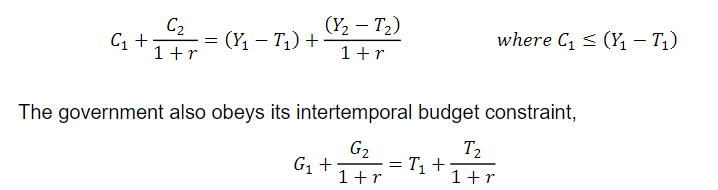
Here 𝐶 is consumption, 𝑇 is taxation, 𝐺 is government expenditure, and 𝑟 is the real interest rate. Subscripts denote periods 1 and 2
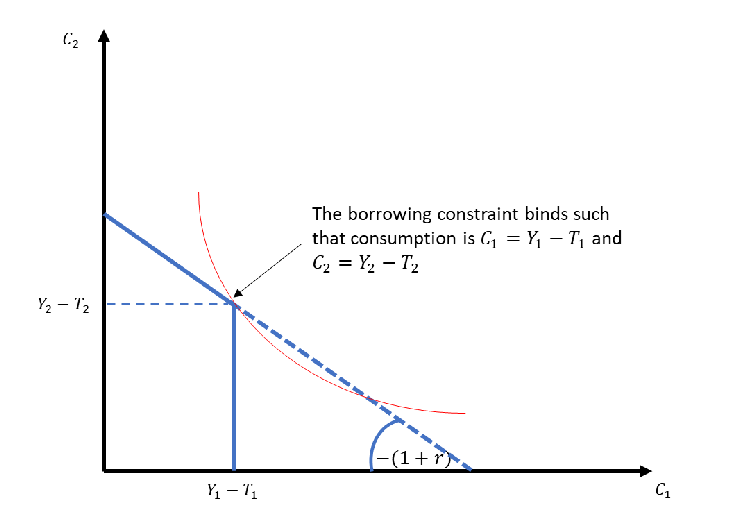
You may assume that household and government face the same real interest rate, 𝑟. Further, suppose that the household has a preference for consumption today, such that its borrowing constraint is binding, forcing it to consume its period–1 income today and period–2 income tomorrow. That is to say, initially 𝐶1 = (𝑌1 − 𝑇1) and 𝐶2 = (𝑌2 − 𝑇2).
This situation is shown in the following diagram.
Now consider a situation where the government tries to stimulate the economy via a tax cut in period 1. The government maintains expenditure in each period at 𝐺1 and 𝐺2, but it cuts taxes to 𝑇1′ in period 1 and consequently increases taxes to 𝑇2′ in period 2, to still obey its intertemporal budget constraint.
Is the fiscal policy via the tax cut effective at stimulating period–1 consumption? Draw a diagram and provide clear explanation about how this example relates to Ricardian Equivalence.